How Often Should Air Conditioning Be Serviced in Mauritius?
Tropical run hours, humidity and coastal salt make the once-a-year rule obsolete here. The intervals that actually protect your units, what a real service visit contains, and the regassing trap to avoid.
In Mauritius, air conditioning should be serviced every 3–4 months in normal commercial use, every 2–3 months in heavy-duty or coastal environments, and at minimum every 6 months for lightly used residential units. Temperate-climate advice of "once a year" does not survive contact with a tropical, humid, salt-laden island where units run most of the year.
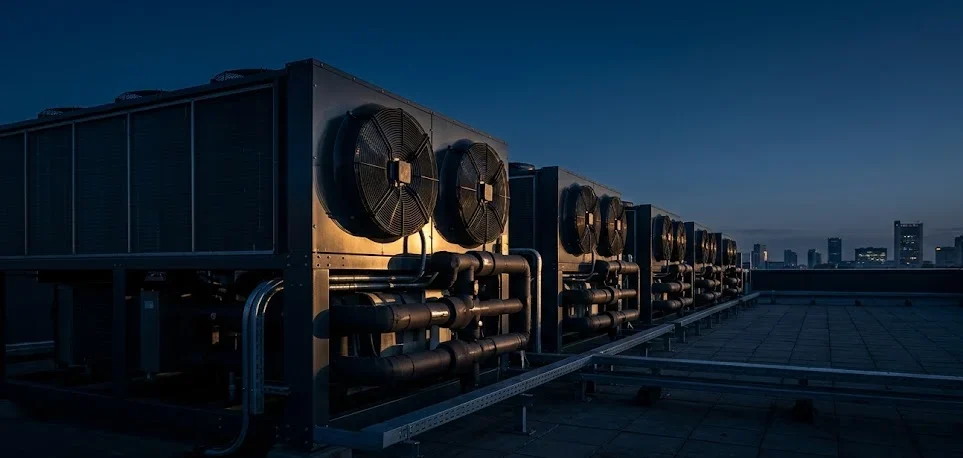
Why the tropics rewrite the service schedule
- Run hours. A Mauritian office unit can run 10–12 hours a day for much of the year. Annual run hours are multiples of a European unit's — wear and fouling scale with hours, not calendar months.
- Humidity. High humidity means heavy condensate. Drain pans and lines foul with biological growth, and a blocked condensate line becomes a stained ceiling — a failure we are called to more often than compressor faults.
- Dust and organic load. Filters and evaporator coils load quickly. A fouled coil insulates itself: the unit runs longer, cools less and draws more current for the same output.
- Salt. Within roughly a kilometre of the coast, airborne salt corrodes condenser fins and cabinets aggressively. Coastal condensers need more frequent washing and protective treatment, or they die young.
Recommended intervals by environment
| Environment | Full service interval | Notes |
|---|---|---|
| Office / commercial, inland | Every 3–4 months | Filter checks monthly where occupancy is dense |
| Coastal properties (<1 km from sea) | Every 2–3 months | Condenser coil wash and corrosion check each visit |
| Server / equipment rooms | Every 2–3 months | Cooling is business-critical; consider redundancy, not just servicing |
| Restaurants, salons, gyms | Every 2–3 months | Grease and product aerosols foul coils fast |
| Residential, light use | Every 6 months | Minimum — ideally before summer |
What a proper service visit includes
A "service" that is only a filter rinse is not a service. Each visit should cover: filter cleaning or replacement; evaporator and condenser coil cleaning; condensate pan and drain-line clearing and treatment; electrical connection, capacitor and current-draw checks; refrigerant operating-pressure check; and a functional test with supply-air temperature recorded. Recording the readings matters — a slowly rising current draw or falling temperature split is how the next failure announces itself early.
“It keeps losing gas — can we just top it up?”
No — and any contractor happy to keep regassing without finding the leak is selling you the same repair on subscription. Refrigerant does not get consumed; if it is low, it escaped. The correct sequence is leak-test, repair, vacuum, then recharge to specification. Repeated top-ups also mean the compressor spends its life running on marginal charge, which is how a Rs 3,000 leak becomes a compressor replacement.
The cost logic
Indicatively, a proper split-unit service in Mauritius runs in the order of Rs 1,000–2,500 per unit per visit, with multi-unit sites priced per visit rather than per unit. Against that: a fouled unit can draw 15–25% more current for less cooling, a blocked condensate line can write off a ceiling, and a neglected compressor failure costs more than years of servicing. For sites with several units, servicing folds naturally into an annual facilities maintenance contract alongside electrical and plumbing PPM — one schedule, one contact, one report. Details of our HVAC scope are on the MEP and HVAC maintenance page.
Service pricing is indicative for Mauritius as at and varies with unit type, access and site location. Multi-unit and contract servicing is quoted after a site survey.
Frequently asked questions
How often should air conditioning be serviced in Mauritius?
Every 3 to 4 months for normal commercial use inland, every 2 to 3 months for coastal sites, server rooms, restaurants and gyms, and at least every 6 months for lightly used residential units. Mauritian run hours, humidity, dust and coastal salt make annual servicing insufficient.
Why do AC units near the sea fail sooner?
Airborne salt corrodes condenser fins, coils and cabinets. Within roughly a kilometre of the coast, condensers need washing and corrosion checks every two to three months and benefit from protective coil treatment, or fin corrosion quietly reduces capacity until the unit fails early.
My AC keeps losing gas. Should I just top it up?
No. Refrigerant is not consumed, so low gas means a leak. The correct repair is leak-test, fix, vacuum and recharge to specification. Repeated top-ups leave the compressor running on marginal charge and turn a small leak repair into a compressor replacement.
What does an AC service cost in Mauritius?
Indicatively Rs 1,000 to 2,500 per split unit per visit, depending on unit type and access, with multi-unit sites priced per visit. Regular servicing typically pays for itself through 15 to 25 percent lower running current, avoided condensate damage and longer compressor life.
Want a figure for your own building? Send us the site location and scope and we will come back with a written quotation.
Or call and WhatsApp +230 5724 5224